Deep Conditioning and Hair Health Restoration
When exploring professional hair treatments, most conversations start with dramatic transformations: sleek keratin results or vivid color work. But underneath every healthy, beautiful head of hair is a foundation built on consistent moisture, protein balance, and structural integrity. That foundation is what deep conditioning treatment salon services are designed to restore and protect. Whether your hair has been weakened by chemical processing, heat styling, environmental stress, or simply time, deep conditioning is one of the most powerful tools in professional hair care. In this guide, we'll break down exactly how professional deep conditioning works, who benefits most, what to expect during a salon treatment, and how to build a long-term strategy for lasting hair health.
What Professional Deep Conditioning Actually Does for Your Hair
At its core, a deep conditioning treatment salon service does something that no regular rinse-out conditioner can accomplish: it penetrates the hair's cortex, the inner layer beneath the outer cuticle, to deliver concentrated moisture, protein, and bonding agents directly where damage originates.
Hair damage isn't just surface-level dryness. When hair is chemically treated, heat-styled repeatedly, or exposed to UV rays and hard water, the protein bonds that give each strand its strength begin to break down. The cuticle layer, those overlapping scales that protect the inner shaft, lifts and chips away, leaving hair porous, rough, and prone to breakage.
The Two Primary Deep Conditioning Categories
Professional deep conditioning treatments generally fall into two categories, and understanding the difference helps you choose the right service:
- Moisture-based treatments: These focus on hydration and elasticity. They're ideal for dry, brittle, or curly hair types that lose water quickly. Ingredients like hyaluronic acid, aloe vera, honey, and plant oils replenish moisture and smooth the cuticle for improved shine and softness.
- Protein-based treatments: These rebuild weakened hair structure using hydrolyzed proteins that temporarily fill in gaps in the hair shaft. They're especially effective for hair that has lost strength and elasticity due to bleaching, relaxers, or excessive heat. Products like Olaplex and K18 use bond-building technology that works at the molecular level to reconnect broken disulfide bonds.
Most professional deep conditioning treatment salon sessions combine both approaches, customized to your specific hair's protein-moisture balance: something a trained stylist can assess during a consultation that your shampoo aisle products simply cannot replicate.
Signs That Your Hair Is Ready for a Professional Treatment
Many clients come in for a deep conditioning treatment salon visit only after their hair has reached a crisis point: severe breakage, gummy texture when wet, or extreme dullness. But ideally, you don't want to wait that long. Learning to recognize early warning signs means you can intervene before damage becomes difficult to reverse.
Common Indicators of Moisture and Protein Deficiency
- Increased tangling and difficulty detangling: Lifted cuticles snag on each other, creating knots that lead to breakage during brushing.
- Loss of shine and reflectivity: Healthy cuticles lie flat and reflect light evenly. Damaged hair appears flat and dull regardless of product use.
- Excessive shedding and breakage, Not to be confused with normal shedding (50-100 strands daily), breakage produces short, uneven pieces rather than strands with a root bulb.
- Gummy or mushy texture when wet: This is a red flag indicating significant protein loss and over-moisturized porosity.
- Frizz that won't respond to styling products: High porosity hair absorbs and releases moisture erratically, leading to persistent, uncontrollable frizz.
If you're experiencing two or more of these symptoms, your hair is already signaling that it needs professional attention. For a closer look at specific warning signs and what they mean for your hair's health, our detailed breakdown of signs damaged hair needs treatment walks through each indicator and explains the underlying causes.
What to Expect During a Deep Conditioning Treatment Salon Visit
One of the most common misconceptions about deep conditioning is that it's simply a longer version of your shower conditioner routine. A professional deep conditioning treatment salon experience is considerably more sophisticated, and the results reflect that difference.
The Step-by-Step Process
Here's what a typical professional session looks like at a quality salon:
- Hair analysis: Before any product touches your hair, a skilled stylist will assess your hair's porosity, density, elasticity, and current damage level. This determines whether you need a moisture-focused, protein-focused, or combined treatment.
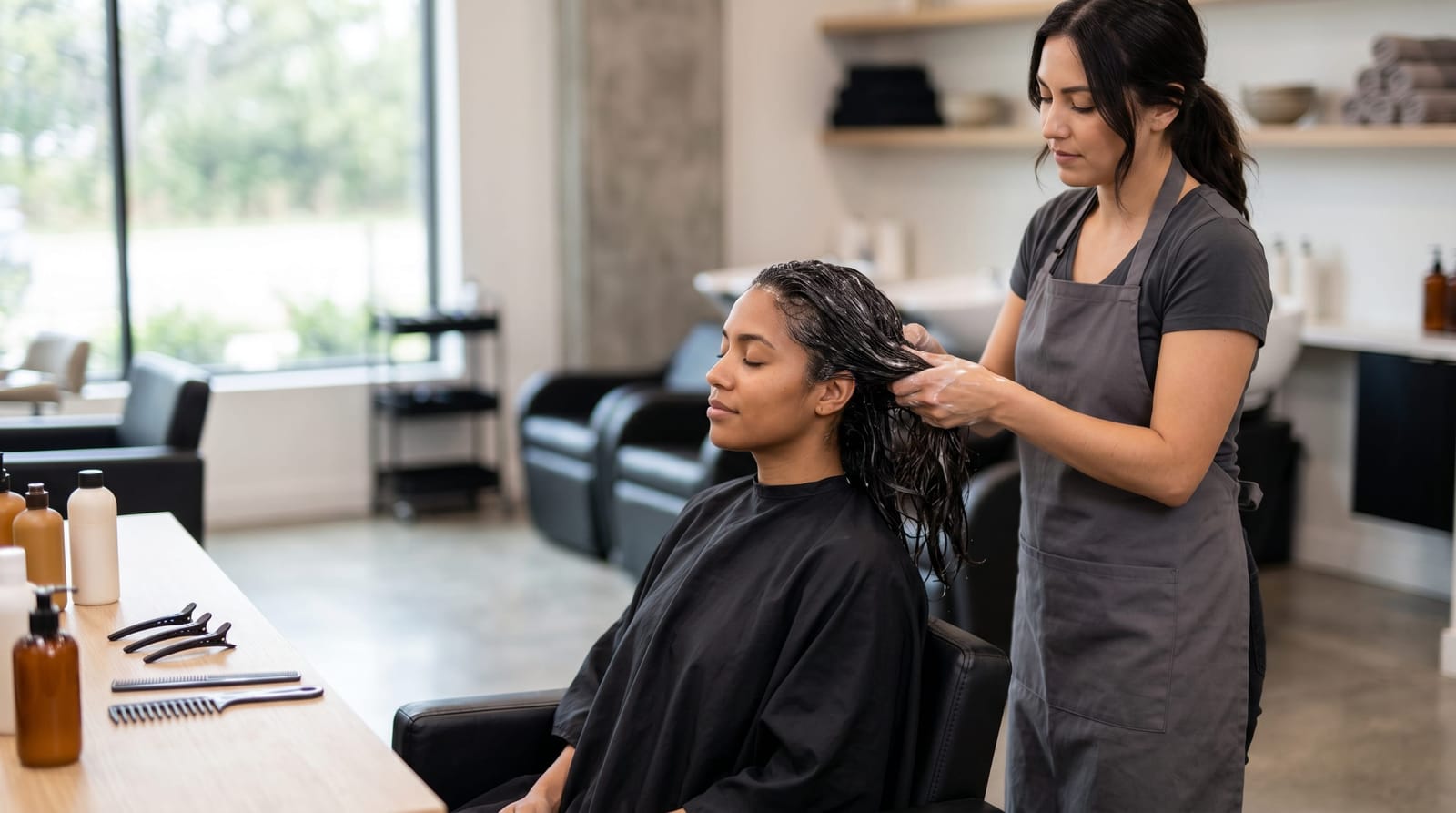
- Clarifying shampoo: A clarifying wash removes product buildup and mineral deposits that block treatment absorption. This is a critical step that most at-home routines skip.
- Treatment application: The deep conditioning formula is applied section by section to ensure thorough, even coverage from root to end. Stylists pay particular attention to the most damaged areas: typically mid-shaft to ends in chemically treated hair.
- Heat activation: A hooded dryer, steamer, or heat cap is used to gently open the cuticle and drive ingredients deeper into the hair shaft. Heat also helps ingredients like Olaplex's bond-building technology work more effectively. Most treatments sit under heat for 20-30 minutes.
- Cool rinse: A cool rinse seals the cuticle back down, locking in moisture and creating that signature post-treatment smoothness and shine.
- Finishing treatment: Depending on your hair type and goals, your stylist may finish with a leave-in conditioner, hair oil, or serum to extend the treatment's benefits.
The entire process typically takes 45 minutes to an hour and a half, depending on hair length and the specific treatment protocol. The results, softer texture, improved elasticity, reduced breakage, and noticeably more shine, are immediately visible.
Treatment Frequency: Building a Long-Term Hair Health Plan
One professional deep conditioning treatment salon visit can produce immediate, noticeable results. But hair health restoration is not a one-and-done event: it's an ongoing process, and frequency matters enormously.
General Frequency Guidelines by Hair Type and Condition
- Severely damaged, heavily processed, or bleached hair: Every 2-3 weeks until integrity improves, then monthly for maintenance.
- Color-treated hair (single process, highlights): Every 4-6 weeks, ideally timed with color appointments.
- Naturally curly or coily hair: Every 2-4 weeks, as these textures are structurally prone to moisture loss along the curl pattern.
- Fine or straight hair with minimal damage: Every 6-8 weeks for preventative maintenance.
- Healthy hair without chemical processing: Every 8-12 weeks as a seasonal reset.
These are starting points, not rigid rules. Your stylist will adjust recommendations based on how your hair responds to treatment and changes in your routine or environment. For a deeper exploration of timing and how to know when your hair needs its next session, our guide on deep conditioning frequency provides specific scenarios and expert recommendations.
It's also worth noting that deep conditioning works best as part of a comprehensive hair care strategy. Clients who pair regular deep conditioning treatments with services like keratin smoothing treatment NJ often see compounded results: the keratin treatment reduces daily friction and heat styling, while deep conditioning continuously replenishes moisture and rebuilds protein bonds between appointments.
Professional Products That Elevate Deep Conditioning Results
Not all deep conditioning treatments deliver the same results, and a significant part of what makes a professional deep conditioning treatment salon service superior to at-home care is the quality of the products used. Professional-grade formulas contain higher concentrations of active ingredients and are often not available for retail purchase.
Bond-Building Treatments: Olaplex and K18
Olaplex revolutionized professional hair care by introducing bond-building chemistry to salons. Its active ingredient, Bis-Aminopropyl Diglycol Dimaleate, works by reconnecting broken disulfide bonds within the hair's cortex: the same bonds that are fractured during bleaching and chemical processing. Olaplex treatments are often used as standalone services or added into color and bleach services to minimize damage in real time.
K18 takes a different approach using a patented biomimetic peptide that reconnects broken keratin chains from the inside out. K18 works in as little as four minutes without heat, making it an efficient add-on to any service. For clients with severe damage, a series of K18 treatments can produce dramatic improvements in strength and elasticity over several weeks.
Both products represent the science-forward direction of modern deep conditioning: moving beyond surface-level softness to genuine structural repair at the molecular level.
Maintaining Deep Conditioning Results Between Salon Visits
The investment you make in a professional deep conditioning treatment salon visit can be extended significantly with the right at-home habits. While at-home products won't replicate the depth of a professional treatment, they play an important supporting role.
At-Home Practices That Protect Your Investment
- Use a sulfate-free shampoo: Harsh sulfates strip moisture and disrupt the lipid barrier that keeps hair hydrated. Sulfate-free formulas cleanse without depleting what your treatment restored.
- Limit heat styling frequency and always use heat protectant: Every time you apply direct heat without protection, you're counteracting the work of your treatment. A quality heat protectant dramatically reduces thermal damage.
- Sleep on a silk or satin pillowcase: Cotton pillowcases create friction that lifts the cuticle and causes breakage overnight. Silk or satin surfaces preserve moisture and reduce mechanical stress.
- Use a leave-in conditioner daily: A lightweight leave-in provides a continuous moisture buffer, especially important in dry or cold climates that accelerate moisture loss.
- Avoid over-washing: Washing hair too frequently, especially with hot water, strips natural oils and undermines deep conditioning results. Most hair types do well with 2-3 washes per week.
Your stylist can also recommend a personalized at-home regimen based on the specific treatment you received and your hair's ongoing needs: this guidance is one of the most underutilized benefits of building a relationship with a professional salon.
Related Topics Worth Exploring
Deep conditioning is one component of a broader approach to hair health and treatment. If you're navigating a specific concern or trying to determine the best path forward for your hair, these related topics provide more targeted guidance:
- Understanding the specific signs damaged hair needs treatment can help you recognize when it's time to book your next appointment rather than waiting for a crisis.
- If you're unsure how frequently your hair needs professional care, our detailed guide on deep conditioning frequency offers tailored recommendations for different hair types and damage levels.
- For clients dealing with persistent frizz and manageability issues alongside damage, combining deep conditioning with a keratin smoothing treatment NJ can address both structural repair and surface smoothing simultaneously.
Conclusion: Restore What Your Hair Has Lost
Healthy hair doesn't happen by accident: it's the result of intentional care, the right professional treatments at the right frequency, and a consistent commitment to protecting what you've built. A professional deep conditioning treatment salon visit is one of the most direct investments you can make in your hair's long-term health, delivering moisture, protein, and structural repair that store-bought products simply cannot match. Whether you're recovering from significant damage or maintaining hair that's already in good shape, deep conditioning belongs in your regular hair care routine.
At Meraki, our stylists begin every treatment relationship with a thorough hair health assessment to ensure you receive exactly the care your hair needs. Ready to restore your hair's strength, softness, and shine? Book your deep conditioning treatment today and experience the difference professional care makes.