Curly and Textured Hair Cutting: Specialized Techniques for Natural Texture
When it comes to professional haircuts and styling, curly and textured hair demands a fundamentally different approach than straight hair, and not every salon understands that difference. The wrong cut can leave curls frizzy, misshapen, or completely stripped of their natural bounce. The right cut, performed by someone who truly understands curl patterns and hair texture, can be genuinely transformative. If you've been searching for a curly hair salon in NJ that treats your texture with the expertise it deserves, understanding what specialized curly cutting actually involves will help you find the right fit. This guide walks through curl typing, cutting techniques, the dry-cutting method, and what to expect from a stylist who genuinely specializes in textured hair.
Why Curly Hair Requires a Different Cutting Philosophy
Straight hair behaves predictably under scissors: cut an inch off and an inch comes off. Curly and textured hair doesn't work that way. Curl coils and springs back when dry, meaning a two-inch trim wet can become a four-inch removal once the hair dries and contracts. This "shrinkage factor" varies dramatically across curl types, from loose waves that shrink maybe 10% to tight coils that can shrink 50% or more of their stretched length.
Beyond shrinkage, curly hair has structural differences at the follicle level. The oval or asymmetrical cross-section of a curly hair shaft makes it naturally more porous and prone to dryness than straight hair. This porosity affects how cuts fall and how styles hold. A stylist who understands hair porosity will factor it into product recommendations and cutting choices.
Perhaps most importantly, curly hair should ideally be evaluated and cut in its natural state, not pulled straight under a comb. When a stylist cuts curly hair while it's wet and stretched, they're making decisions based on a version of the hair that doesn't reflect how it actually lives and moves. This is why specialized curly cutting techniques are so different from traditional salon approaches.
The Problem with Generic Cuts on Curly Hair
Many clients with curly hair have experienced the frustration of leaving a salon with a cut that looked fine while they were in the chair, only to arrive home and find their curls looking triangular, too bulky, or unevenly shaped. This almost always comes down to a stylist who applied straight-hair cutting logic to textured hair. Thinning shears used aggressively on curly hair, for instance, can disrupt the curl pattern and create frizz rather than reducing bulk. A specialized curly stylist knows to avoid these pitfalls.
Understanding Curl Patterns and Hair Typing
Not all curly hair is the same. The Andre Walker hair typing system, popularized through the natural hair community, classifies curl patterns on a spectrum from Type 2 (wavy) through Type 3 (curly) to Type 4 (coily/kinky), with subcategories A through C indicating curl tightness within each type. While this system has its limitations, it gives stylists and clients a shared vocabulary for discussing texture.
Type 2: Wavy Hair
Wavy hair (2A, 2B, 2C) forms loose S-shaped waves rather than defined spirals. It tends to sit flatter at the roots and is most susceptible to losing its wave with the wrong cut. Layering is typically key for wavy hair, without it, the weight of the hair can pull the wave pattern flat. Overly blunt cuts at the ends can make wavy hair look boxy.
Type 3: Curly Hair
Type 3 curls (3A through 3C) range from loose, large spirals to tight corkscrew curls. This category covers a huge range of textures and requires careful attention to how each individual curl coils. Type 3 hair often benefits from a cut that removes bulk from the interior without shortening the overall length dramatically, preserving the spiral shape while allowing the curls to clump and define naturally.
Type 4: Coily and Kinky Hair
Type 4 hair (4A, 4B, 4C) has the tightest curl patterns, ranging from small defined coils to a more zigzag or undefined kink pattern. This hair type experiences the most significant shrinkage and requires the most care during cutting. Many stylists who specialize in natural Black hair textures work primarily with Type 4 clients, developing deep expertise in shaping afros, twist-outs, wash-and-go styles, and protective cuts that honor the hair's natural volume and pattern.
The Dry Cutting Method: Why It Changes Everything
Dry cutting, also called the DevaCut method or simply "cutting curls dry", is widely considered the gold standard for textured hair. The principle is simple: cut the hair in its natural, dry state so you can see exactly how each curl falls, where the weight sits, and how the overall shape behaves in real life.
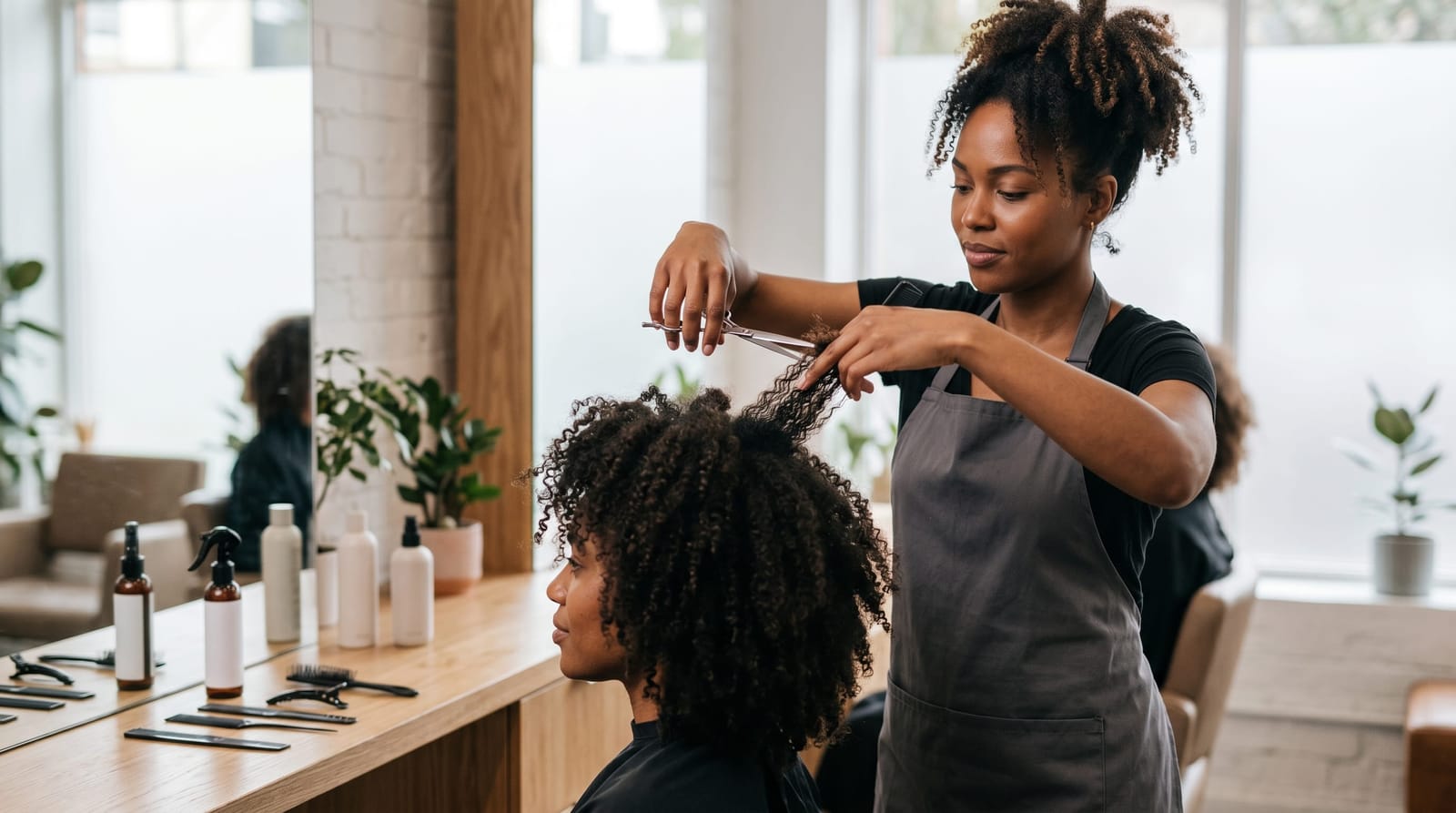
When a stylist cuts curly hair dry, they're working with the hair as it actually exists. They can see which curls are longer than they appear, where the shape is unbalanced, and how different sections interact with each other. Individual curls are cut one at a time or in small sections, with the stylist working with the curl's natural coil rather than against it.
Wet Cutting vs. Dry Cutting for Curls
Some stylists use a combination approach: doing initial shaping or detangling work on wet hair, then refining the cut once the hair has dried. This hybrid method can work well when a more dramatic length change is involved. A skilled curly stylist will communicate which approach they're using and why, helping clients understand the process rather than simply performing a service.
Curl-by-Curl Cutting Technique
In a true curl-by-curl cut, the stylist releases individual curls and cuts them according to their natural coil, rather than cutting across a blunt horizontal line. This technique creates shape that moves with the curl pattern instead of working against it. The result is a cut that looks intentional and healthy whether the client wears their hair in a wash-and-go, a diffused blowout, or twisted styles.
Techniques That Enhance Natural Texture
Beyond the basic dry-cutting approach, specialized curly stylists use several techniques to enhance texture and create shape that serves each client's specific curl pattern.
Interior Thinning vs. Surface Thinning
For clients with high-density hair who feel overwhelmed by volume, thinning needs to happen inside the hair, not at the surface. Removing weight from the interior of a curl section allows the curl to spring up and define itself without the frizzy, disrupted surface that comes from thinning shears used on the outside of curls. A skilled stylist uses point cutting or careful slicing techniques through the interior bulk while leaving the outer curl structure intact.
Dusting: The Minimal Trim Technique
Many curly-haired clients are reluctant to cut their hair because of shrinkage: they've worked hard to grow length and don't want to lose it. "Dusting" is a technique where only the very tips of the curls are trimmed, just enough to remove splits and damage without taking any noticeable length. For clients who are growing their hair out, a dust every few months keeps the ends healthy and prevents breakage from working its way up the hair shaft.
Shaping the Silhouette
Every curly haircut should be designed with the client's overall head shape and face shape in mind. A great curly stylist isn't just cutting individual curls: they're sculpting a silhouette. This might mean leaving more length at the crown to elongate a round face, building volume at the sides to balance a longer face, or creating a tapered shape that gives definition without making the hair look bottom-heavy. This is the same artistry involved in hair layering and shaping for any texture, applied through the lens of curl behavior.
Consultation: What to Expect from a Specialized Curly Stylist
A good consultation before a curly cut is non-negotiable. Before any scissors touch your hair, a specialized stylist should spend time understanding your curl pattern, your hair history, your current routine, and your styling goals. This conversation shapes every decision that follows.
During a thorough consultation, expect the stylist to ask about:
- How you currently wear your hair on a daily basis
- What products you use and how long your wash routine takes
- Whether you've had chemical treatments (color, relaxers, keratin) that may have altered your natural curl pattern
- Your length goals and whether you want to add or remove volume
- Any past cutting experiences that left you disappointed, and what went wrong
This is also the time to ask your own questions. Don't hesitate to ask the stylist to walk you through their technique, how they learned to cut curly hair, and what results you can realistically expect. A stylist who specializes in curly and textured hair will welcome these questions: they're a sign of an informed client who cares about their hair.
The Importance of a Proper Wash Before Your Cut
For a dry cut to be truly effective, your curls need to be in their best natural state when you arrive at the salon. Most curly hair specialists will either wash your hair in-salon with their preferred products or ask you to arrive with freshly washed, product-free hair that you've allowed to air dry naturally. Arriving with product buildup or heat-straightened hair makes it impossible for the stylist to accurately read your curl pattern.
Styling Curly Hair After a Specialized Cut
A great cut is only the beginning. The way you handle your curls after leaving the salon plays a huge role in whether your results last. Learning curly hair styling tips specific to your cut and texture will help you replicate what your stylist created in the chair, and keep your curls looking their best between appointments.
Key post-cut care principles include:
- Applying products to soaking-wet hair: Curly hair absorbs products best when thoroughly saturated. Applying leave-in conditioner and curl cream to dripping-wet hair helps the product distribute evenly through the curl structure.
- Plopping or diffusing: Air drying with a microfiber towel plop reduces frizz without disturbing the curl clumps your cut was designed to create. Diffusing on low heat preserves curl definition while speeding up dry time.
- Refreshing, not re-washing: Curly hair doesn't need to be washed daily, and over-washing strips the natural oils that keep curls moisturized. A good curl refresh routine using water and a light leave-in can extend the life of your style between wash days.
Related Topics Worth Exploring
Curly and textured hair care touches on many areas of expertise beyond the cut itself. If you're also exploring other styling options, it's worth understanding how the same attention to individual texture applies across women's haircuts in Mountainside NJ and beyond: the best stylists bring a texture-aware approach to every service. For clients who prefer shorter styles, the precision and understanding of natural texture is equally important in men's haircuts in Westfield NJ, where tight curls and coils require the same specialist knowledge at shorter lengths.
We're also developing a detailed guide on hair layering and shaping that explores how movement and dimension are built into cuts for all textures, including how layering interacts specifically with curl patterns to create shape without sacrificing length.
Conclusion: Your Curls Deserve a Specialist
Curly and textured hair is not a niche: it's a significant portion of the population whose hair has historically been underserved by salons trained primarily in straight-hair techniques. Finding a stylist who genuinely understands curl patterns, dry cutting, and texture-specific shaping isn't a luxury. It's the baseline for a cut that actually works with your hair rather than against it.
At Meraki, we bring specialized knowledge of curly and textured hair to every appointment, from the initial consultation through the final style. If you're ready to experience a cut designed around your natural texture, we'd love to meet your curls. Book your curly hair consultation today and let's build a cut that works as hard as your curls do.