Deep Conditioning for Curly Hair: Why It's Essential and How Often to Do It
If you've explored our complete guide to curly and textured hair care, you already know that curly hair has its own set of rules, and moisture is at the top of the list. No other step in a curly hair routine delivers results quite like deep conditioning. It's the treatment that separates dull, frizzy, hard-to-manage curls from the soft, defined, springy ones you're aiming for. But knowing why deep conditioning works and how often to actually do it can feel surprisingly unclear. In this post, we're covering everything: why curly hair loses moisture faster than other hair types, what deep conditioning does that your regular rinse-out conditioner simply can't, and how to build a frequency routine tailored to your specific curl pattern and hair needs, whether you're doing it at home or booking a professional treatment at the salon.
Why Curly and Textured Hair Is So Prone to Dryness
To understand why deep conditioning matters so much for curly hair, it helps to understand what makes curly and textured strands behave differently from straight hair in the first place.
The natural oils produced by your scalp, the ones that keep hair moisturized and protected, travel down the hair shaft easily on straight strands. On curly and coily hair, that journey is much more difficult. Because the hair bends, coils, and spirals, those oils struggle to reach the mid-lengths and ends. The result? The sections of your hair that need moisture most tend to receive the least of it naturally.
There's also the matter of the hair's outer layer, called the cuticle. On curly and textured hair, the cuticle tends to sit in a slightly more open or raised position compared to straight hair. While this allows moisture to enter the strand more easily, it also means that moisture escapes just as quickly, especially in dry climates, cold weather, or after heat exposure.
Add in everyday friction from styling, environmental humidity changes, and the fact that many curly-haired people wash their hair less frequently to avoid stripping natural oils, and you have a hair type that is working hard to stay hydrated. Deep conditioning steps in to replenish that moisture from the inside out, and to strengthen the hair so it holds onto hydration longer between washes.
What Deep Conditioning Actually Does (and Why It's Different From Regular Conditioner)
Your everyday rinse-out conditioner is a surface-level treatment. It smooths the cuticle, reduces tangles, and makes hair easier to comb through, and it does those things well. But it's designed to sit on the hair for a few minutes at most, which limits how deeply it can penetrate the strand.
Deep conditioners are formulated differently. They contain higher concentrations of moisturizing and strengthening ingredients: things like humectants that draw water into the strand, emollients that seal the cuticle, and proteins that reinforce the hair's internal structure. They're meant to be left on for anywhere from 15 minutes to an hour (sometimes longer with heat), giving those ingredients time to work their way into the hair shaft rather than just coating the outside.
The results go beyond surface softness. Over time, consistent deep conditioning:
- Restores elasticity so curls stretch without snapping
- Reduces breakage during detangling and styling
- Minimizes frizz by keeping the cuticle smooth and sealed
- Enhances curl definition and natural shine
- Improves how well your hair responds to styling products
Think of it as a reset for your hair: one that becomes more impactful the more consistently you do it. A single treatment will make a noticeable difference, but building it into your regular routine is where the real transformation happens.
Deep Conditioning Frequency by Hair Type
One of the most common questions curly-haired clients ask is: how often should I actually deep condition? The honest answer is that it depends on your specific hair type, porosity, and condition. There's no single universal schedule, but there are some reliable guidelines to start from.
Weekly: Most Curly and Coily Hair Types
For the majority of people with curly (type 2C-3C) and coily (type 4A-4C) hair, a weekly deep conditioning session is the gold standard. This frequency keeps moisture levels consistently topped up, which is especially important for tighter curl patterns that are naturally drier. If your hair feels rough, tangles easily, or loses definition quickly after styling, weekly treatments are a good place to start.
Every 10 to 14 Days: Low Porosity Hair
Low porosity hair has a tightly sealed cuticle that makes it harder for moisture to penetrate, but once moisture is in, it tends to stay. If you have low porosity hair, you may find that too-frequent deep conditioning leads to buildup or limp, weighed-down curls. Spacing treatments out to every 10 to 14 days, and applying your deep conditioner with gentle heat (like a warm towel or hooded dryer) to help open the cuticle, tends to work better.
Twice Weekly: High Porosity Hair
High porosity hair, whether naturally so or from color treatments, heat styling, or chemical processes, absorbs moisture quickly but loses it just as fast. If your hair is high porosity, you may benefit from deep conditioning twice a week, particularly during dry seasons or after any chemical service. Protein-rich deep conditioners can also help reinforce the cuticle structure over time.
Adjust for Seasonal and Lifestyle Factors
Your deep conditioning schedule isn't set in stone. Cold winters, low-humidity environments, increased heat tool use, and color or chemical treatments all increase your hair's moisture needs. Pay attention to how your hair feels between washes, if it's feeling drier or more brittle than usual, increase your frequency. If it's feeling weighed down or product-saturated, pull back slightly. Your hair will tell you what it needs.
DIY vs. Professional Deep Conditioning Treatments
Both at-home and in-salon deep conditioning treatments have their place in a healthy curl care routine, and ideally, they work together rather than in competition.
At-Home Deep Conditioning
At-home treatments are your weekly maintenance: the consistent habit that keeps your hair in good condition between salon visits. A quality store-bought or boutique deep conditioner applied after shampooing, left on for 20 to 30 minutes under a shower cap, and rinsed with cool water can make a significant difference over time. The key is choosing a formula suited to your hair type and using it consistently.
For added effectiveness at home, applying gentle heat, either from a warm towel wrapped around your head or a hooded dryer, helps open the cuticle so the conditioner penetrates more deeply. This simple step elevates a basic at-home treatment considerably.
Professional In-Salon Treatments
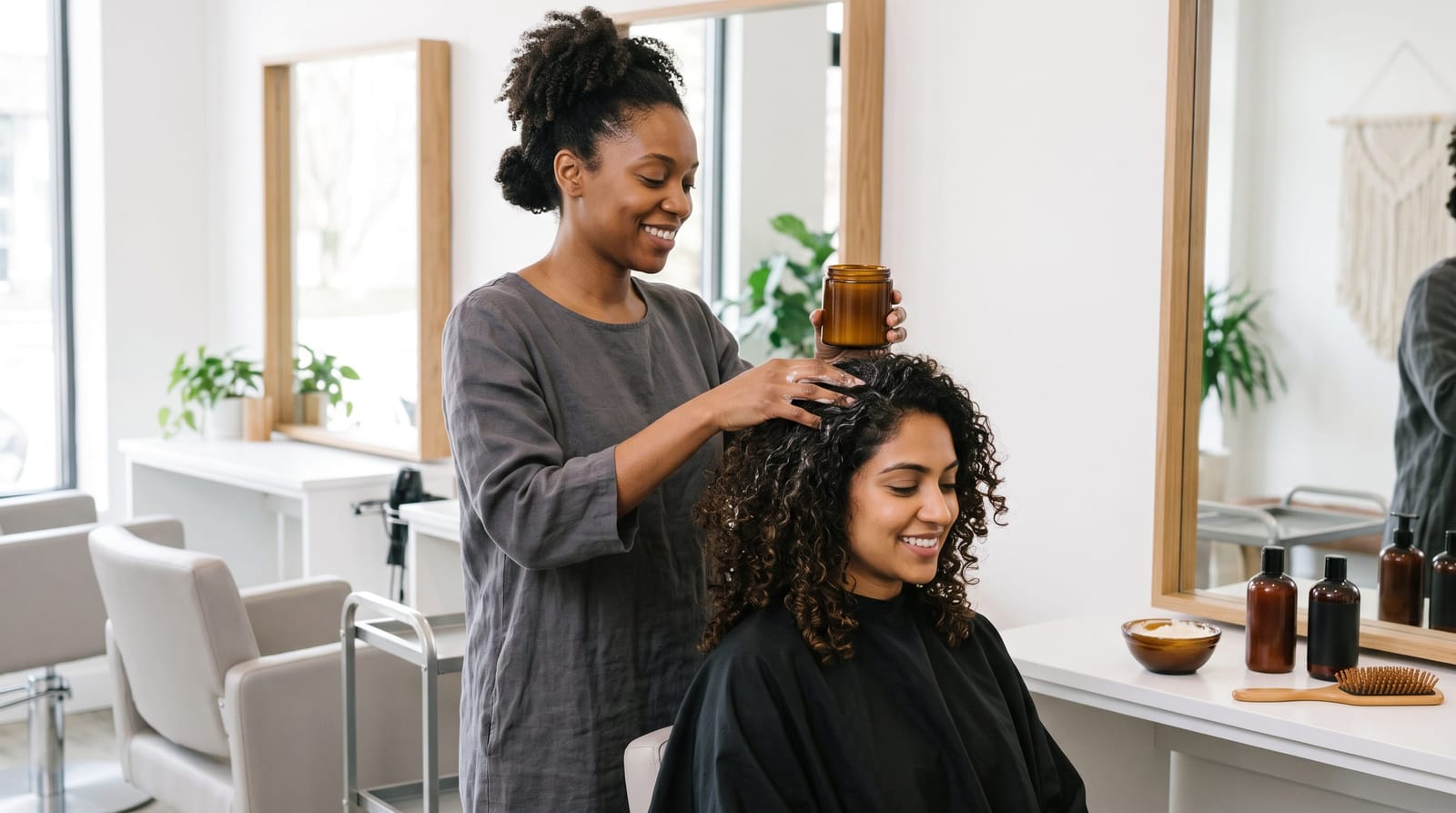
Professional deep conditioning treatments are a step above what's achievable at home, and not just because of the product quality. Salon-grade formulas are more concentrated and targeted, and your stylist can customize the treatment based on your current hair condition, porosity, and any recent chemical or color services. Professional treatments also often include a scalp massage, steam application, and processing under a professional hooded dryer, all of which enhance penetration and results.
At Meraki, our in-salon deep conditioning services are designed specifically with curly and textured hair clients in mind. Whether you're dealing with dryness from color, seasonal damage, or simply want a professional-level moisture reset, our team can walk you through the right treatment for your hair. Curious about how a deep conditioning treatment salon service compares to your at-home routine? We break that down in more detail for clients who want a deeper look at what professional treatments offer.
A good rhythm for many clients is consistent at-home maintenance weekly, with a professional treatment every four to six weeks, or whenever they're in for a cut or color service.
How to Get the Most Out of Every Deep Conditioning Session
The treatment itself matters, but so does how you apply it. A few adjustments to your technique can significantly improve your results.
- Start with a clean slate. Deep conditioner works best on freshly shampooed hair. Buildup from styling products can create a barrier that prevents the treatment from penetrating the strand effectively.
- Apply to soaking wet hair. Don't towel dry before applying. Wet hair allows the conditioner to distribute evenly and begin absorbing right away.
- Work in sections. For thick or coily hair especially, working in sections ensures every strand gets thoroughly coated from root to tip.
- Use heat when you can. Even a warm towel makes a difference. Heat opens the cuticle and allows deeper penetration of the conditioning ingredients.
- Don't rush the timer. At least 20 to 30 minutes is the minimum for a meaningful treatment. If you have the time, 45 minutes to an hour is even better.
- Rinse with cool water. Finishing with cool or lukewarm water helps seal the cuticle back down, locking in the moisture you just added.
Pairing your deep conditioning routine with the right styling approach makes an even bigger difference. If you're looking to build on these results, our guide to curly hair styling tips covers how to work with your freshly conditioned hair to enhance definition and manage frizz throughout the week.
Building Deep Conditioning Into Your Overall Curl Care Routine
Deep conditioning doesn't exist in isolation: it's most effective when it's part of a thoughtful overall routine. Understanding your hair's full picture, from how it's cut to how it's styled, makes every individual step more effective.
For example, a great haircut designed for your specific curl pattern can dramatically reduce the amount of work your deep conditioning has to do. When curls are shaped correctly and weight is distributed properly, they retain moisture better and spring back more easily after washing. If you haven't worked with a stylist who specializes in curly hair, it's worth exploring what that difference looks like: our post on what sets a curly hair salon NJ apart from a general salon explains it well.
Similarly, how your hair is layered and shaped plays into moisture retention. The right cut allows products, including your deep conditioner, to distribute more evenly and do their job more effectively. You can learn more about that connection in our piece on products for layered hair and how cut and care work together.
When deep conditioning is one part of a routine that also includes the right shampoo, leave-in products, and a cut that suits your natural texture, the results are cumulative. Each element supports the others, and your hair reflects that consistency over time.
A Note on Adjusting as Your Hair Changes
Hair isn't static. Hormonal changes, seasonal shifts, color services, dietary changes, and even switching up your styling tools can all affect how your hair responds to moisture. A routine that worked perfectly six months ago might need adjusting, and that's completely normal.
For a more detailed breakdown of how to fine-tune your deep conditioning frequency based on your specific hair condition and lifestyle, we've put together a dedicated resource that goes deeper into the decision-making process. It's a helpful reference when you're not sure whether to increase or pull back on your treatments.
Final Thoughts
Deep conditioning is one of the most impactful things you can do for curly and textured hair, and it doesn't have to be complicated. Understanding your hair's porosity, starting with a frequency that makes sense for your curl type, and staying consistent are the foundations of a routine that actually works. Whether you're building a weekly at-home habit or adding a professional treatment to your salon visits, your curls will respond to the consistent care. If you'd like personalized guidance on what your hair needs, our team at Meraki is here to help: book a consultation and let's build a routine that works for you.