Curly and Textured Haircuts: What Makes a Curl Specialist Different?
When it comes to curly and textured hair, a great haircut is about so much more than trimming the ends. If you've ever left a salon with curls that looked uneven, shapeless, or somehow both too short and too bulky at the same time, you're not alone, and you're not imagining things. Cutting curly hair requires a completely different set of skills, techniques, and instincts than cutting straight hair. As part of our Ultimate Guide to Curly and Textured Hair Care, this post dives into what those differences actually are: why curl-specific cutting techniques matter, what a trained curl specialist understands that a general stylist might not, and why finding the right hands for your curls, especially here in New Jersey, makes all the difference in how your hair looks and feels every single day.
Why Curly Hair Cuts Differently Than Straight Hair
At its most basic level, the difference comes down to physics. Straight hair behaves predictably when cut: what you see wet is roughly what you get dry, length is easy to gauge, and the hair falls in a consistent direction. Curly and textured hair doesn't follow those same rules, and that's exactly what makes it so beautiful and so easy to get wrong in the wrong hands.
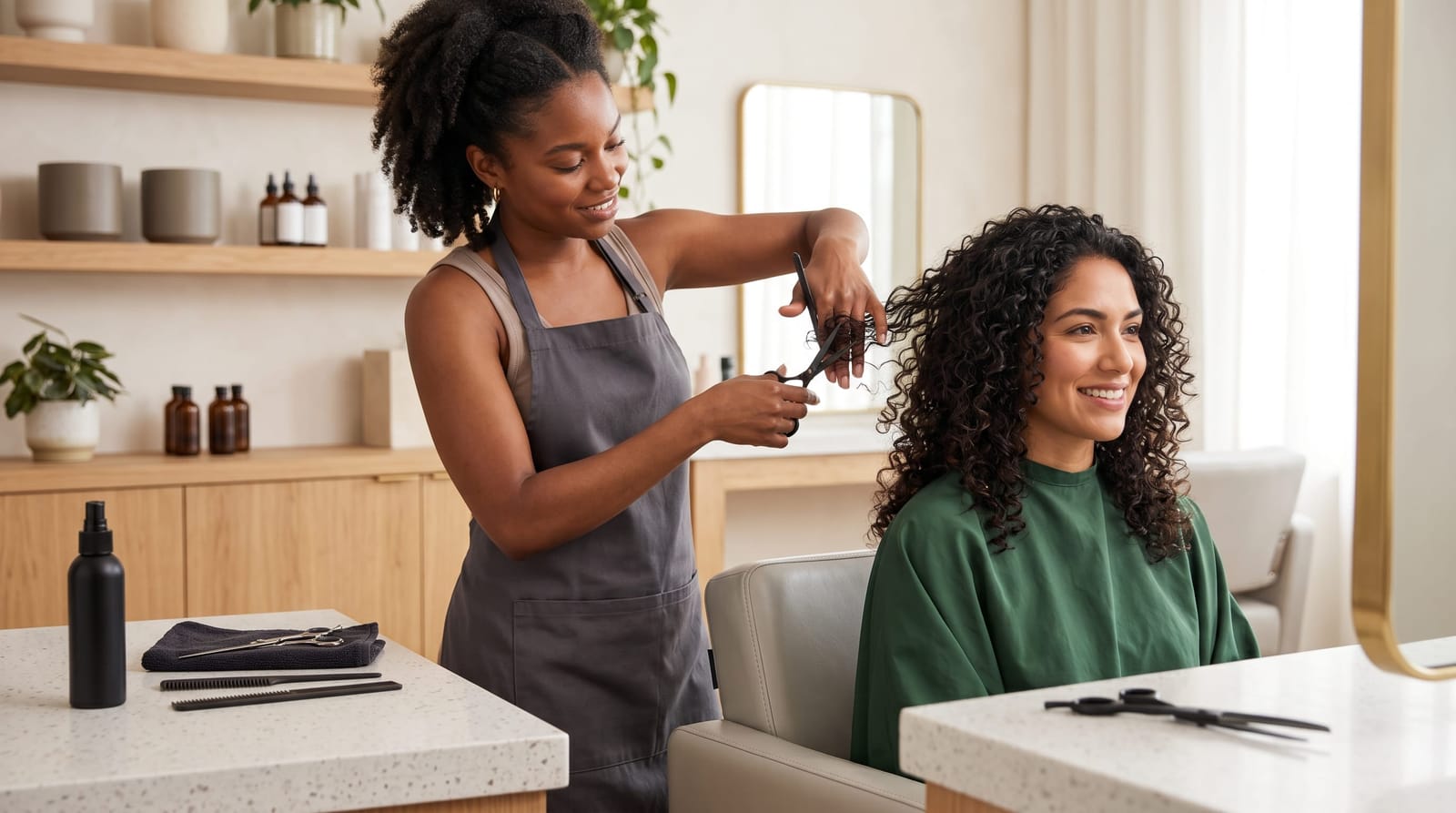
Curly hair coils, springs, and moves in three dimensions. Every curl follows its own path from root to tip. When a stylist cuts curly hair the same way they'd cut straight hair, pulling it taut, measuring from the ends, and trimming in straight lines, they're essentially cutting the hair in a state it will never actually be in. The moment the tension releases and the curl contracts, the shape falls apart.
A curl specialist understands that curly hair needs to be evaluated, shaped, and cut while respecting its natural movement. That means accounting for how each section will behave once it springs back into its natural pattern, how different parts of the head may have different curl textures, and how the overall shape of the cut will read once the hair is fully dry and styled.
The Role of Curl Pattern and Texture Variation
Most people with curly or textured hair don't have a single uniform curl pattern across their entire head. It's common to have looser waves at the crown, tighter coils at the nape, and everything in between at the sides. A skilled curl specialist takes a thorough consultation before ever picking up the scissors: mapping the client's texture, identifying variation across sections, and building a cut that works with all of it rather than forcing it into a one-size-fits-all shape.
Understanding Shrinkage: The Invisible Factor in Every Curl Cut
One of the most important concepts in curly hair cutting, and one of the most commonly overlooked by stylists who don't specialize in texture, is shrinkage. Shrinkage refers to how much shorter curly hair appears when it's in its natural, dry state compared to when it's stretched or wet. Depending on the tightness of the curl, hair can appear anywhere from 20% to more than 50% shorter than its actual length.
This matters enormously in the cutting process. A stylist who doesn't account for shrinkage might cut what looks like two inches while the hair is wet, not realizing that once dry, the curls will pull up significantly more than expected. The result? A haircut that ends up much shorter than the client wanted, with a shape that doesn't match what was discussed in the consultation.
How Curl Specialists Account for Shrinkage
Experienced curl stylists develop an intuition for shrinkage over time, and they factor it into every decision. When a client says they want to keep their length, a curl specialist knows to remove far less than that measurement looks like when the hair is wet or stretched. They also know that shrinkage isn't uniform: looser sections may barely pull up at all, while tighter sections at the back or temples might spring up dramatically. Shaping a curl cut that accounts for this variation across the head is a skill that takes real training and hands-on experience to develop.
Dry Cutting vs. Wet Cutting for Curly Hair
The debate between dry cutting and wet cutting is one of the most talked-about topics in the curly hair world, and for good reason. Both approaches have their place, but they serve very different purposes, and knowing when to use each one is a hallmark of a true curl specialist.
Traditional wet cutting works well for certain textures and techniques, particularly when a stylist needs to create clean internal layers or structure within the cut. Wet hair is more manageable and easier to section precisely, which can be useful in the early stages of building a curl shape. However, wet cutting has a significant limitation: you can't fully see how the curl is going to behave until it dries. For clients with strong curl patterns or significant shrinkage, wet cutting alone can make it very difficult to predict the final result.
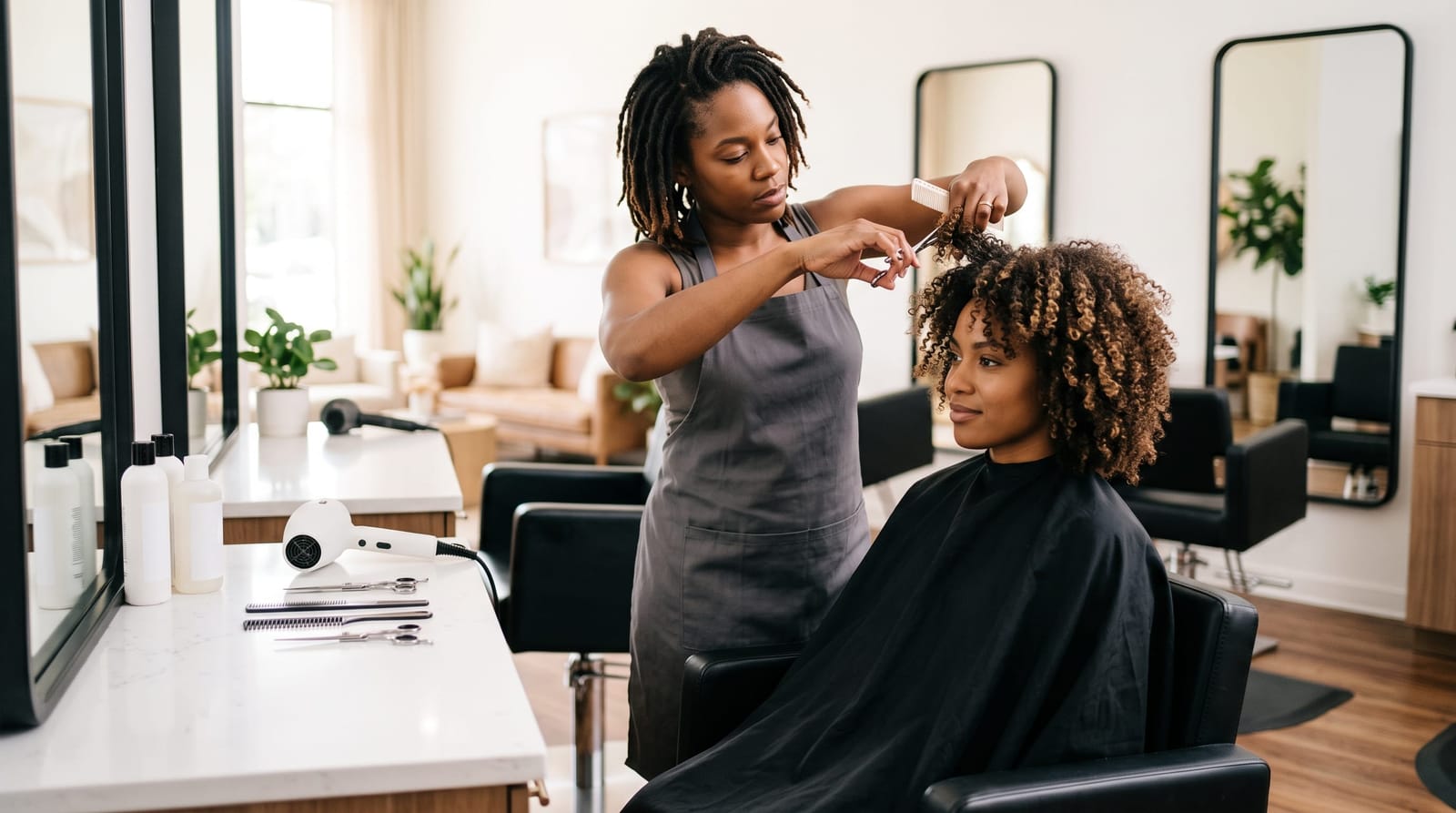
Dry cutting, cutting curly hair while it's fully dry and in its natural state, allows the stylist to see exactly how the curl behaves, how the shape falls, and where adjustments need to be made in real time. Many curl specialists prefer to do their primary shaping work dry, then finish with detail work on wet hair, or vice versa depending on the technique being used.
For a deeper look at how this decision plays out in practice, curly hair styling tips covers the wet versus dry cutting question in detail, including what to ask your stylist before your appointment.
Layering and Shaping: Building a Cut That Works With the Curl
Layering is one of the most powerful tools in a curl specialist's kit, and one of the most misunderstood. In straight hair, heavy layering creates movement and reduces weight. In curly hair, the wrong kind of layering can create frizz, uneven texture, and a loss of curl definition. The right kind of layering, done with an understanding of how curls clump and coil, can completely transform the shape and volume of a curl cut.
The Difference Between Curl-Friendly Layering and General Layering
Curl-friendly layering works with the curl's natural clumping pattern rather than disrupting it. Rather than thinning sections randomly or creating sharp lines, a curl specialist sculpts layers that allow curls to stack on top of each other naturally, creating volume in the right places and reducing bulk where it's not wanted. The goal is always to enhance the curl's natural movement, not to fight it.
Techniques like Ouidad's carving and slicing method, the Deva Cut, and other curl-specific approaches have formalized some of these principles, but at their core they all share the same foundation: respect the curl's natural pattern, work with the hair's three-dimensional movement, and build a shape that holds up on wash day, not just in the salon.
Shaping for Face Framing and Overall Silhouette
Beyond the layering itself, a curl specialist thinks carefully about overall silhouette. Curly hair is naturally voluminous, which means the shape of the cut reads very differently than it would on straight hair. A cut that creates a rounded, balanced silhouette on a straight-haired client might create a wide, triangular shape on someone with curly hair. Skilled curl stylists shape specifically for the three-dimensional result: considering how the hair will sit at the sides, how it frames the face, and how volume is distributed from root to tip.
The Consultation: Where a Great Curl Cut Really Begins
Perhaps the clearest sign of a true curl specialist is what happens before the scissors ever come out. A thorough consultation isn't just polite: it's essential for curly hair clients. Your stylist should ask about your curl history, your current routine, how you typically style your hair at home, and what results you're actually hoping for. They should look at your hair in its natural state, assess your texture and density, and talk through realistic expectations based on your specific curl pattern.
This consultation process is also the right time to ask questions. If you're navigating the process of choosing a stylist, our guide on curly hair salon NJ can help you know exactly what to look for and what questions to bring into that first conversation.
At Meraki Salon in New Jersey, our stylists approach every curly hair appointment with this kind of intentional, individualized consultation. We take the time to understand your hair, not just what it looks like today, but how it behaves, what your lifestyle looks like, and what kind of results will feel genuinely beautiful and manageable for you.
Why Trained Curl Specialists in NJ Make a Real Difference
New Jersey has a genuinely diverse population with an enormous range of hair textures, and that means there's both a real need for curl expertise and a real difference between salons that have it and salons that don't. Clients with wavy, curly, and tightly coiled hair have historically had to work harder to find stylists who truly understand their texture, and the results of going to the wrong salon can take months to grow out.
A curl specialist brings more than just technique to the table. They bring an understanding of how different textures behave under different conditions, how products interact with the cut and the curl pattern, and how to coach clients on maintaining their shape between appointments. That kind of education doesn't happen overnight: it comes from dedicated training, hands-on experience with a wide range of textures, and a genuine investment in understanding curly hair as its own specialty.
Thinking about how often to come in for a trim? That's another area where curl-specific guidance makes a difference. Take a look at our post on haircut frequency schedule for a breakdown of how often curly and textured hair clients should typically book their next appointment.
And once you've got a great cut in place, the next step is making the most of it at home. Our curly hair styling tips post walks through the products, techniques, and daily habits that help your curls look their best between salon visits.
What to Look for in a Curly Hair Salon in NJ
If you're searching for a curly hair salon in NJ that truly understands your texture, there are a few things worth looking for beyond a pretty Instagram feed. Ask about the specific training your stylist has received in curly and textured hair. Look for a salon that uses a consultation-first approach rather than jumping straight into the cut. Notice whether the stylist asks thoughtful questions about your hair and your routine, or whether they approach your appointment the same way they'd approach any other client.
The best curl specialists aren't just technically skilled: they're genuinely curious about your hair and invested in helping you understand it better. That combination of skill, education, and care is what separates a good haircut from a great one.
Conclusion
Curly and textured hair deserves a stylist who truly understands it: someone who knows how to account for shrinkage, read a curl pattern, layer for shape rather than disruption, and cut with the final dry result in mind. That level of expertise doesn't come standard; it comes from dedicated training and real experience with the full spectrum of curl types. At Meraki Salon, we believe every client with curly or textured hair deserves a stylist who treats their texture as the specialty it is. If you're ready to experience what a genuinely curl-informed cut feels like, we'd love to meet your curls. Book a consultation with our team and let's start building a shape that works beautifully for you.